Summary
Program managers reduce scheduling delays in cross-functional decisions by shortening the time between “we need a decision” and “the right people are together to make it.”
Teams can analyze information, draft recommendations, produce deliverables, and resolve technical questions faster than before. But a decision involving Security, Finance, Legal, IT, a vendor, and an executive can still move at the speed of everyone’s calendars.
As execution gets faster, coordination can become the new bottleneck.
I have spent about 30 years in consulting, including working on and leading large transformation programs where coordinating workstreams, executives, clients, vendors, and decision-makers was part of the job. Earlier in my career, I worked as an ERP release manager, so I have experienced firsthand what happens when an issue is ready for a decision but the right people are difficult to assemble.
Today, I advise CalendarBridge, where we work on this problem from another angle. CalendarBridge helps people and organizations coordinate across calendars, accounts, and companies, and I regularly hear from customers and prospects dealing with the same friction I saw on large programs.
One reason CalendarBridge has a useful perspective here is that calendars sit where program plans meet actual commitments. A governance model may tell you who needs to make the decision. The calendars tell you whether those people can actually get together to make it.
For program managers, the opportunity is to redesign the coordination around important decisions instead of treating every meeting as a fresh scheduling exercise.
Coordination can become part of the critical path
Consider a transformation team that discovers a security issue Monday. By Tuesday, the technical team and vendor understand the problem and agree on a recommendation. Legal needs to weigh in, and an executive sponsor must approve the change. The first meeting everyone can arrange is Friday.
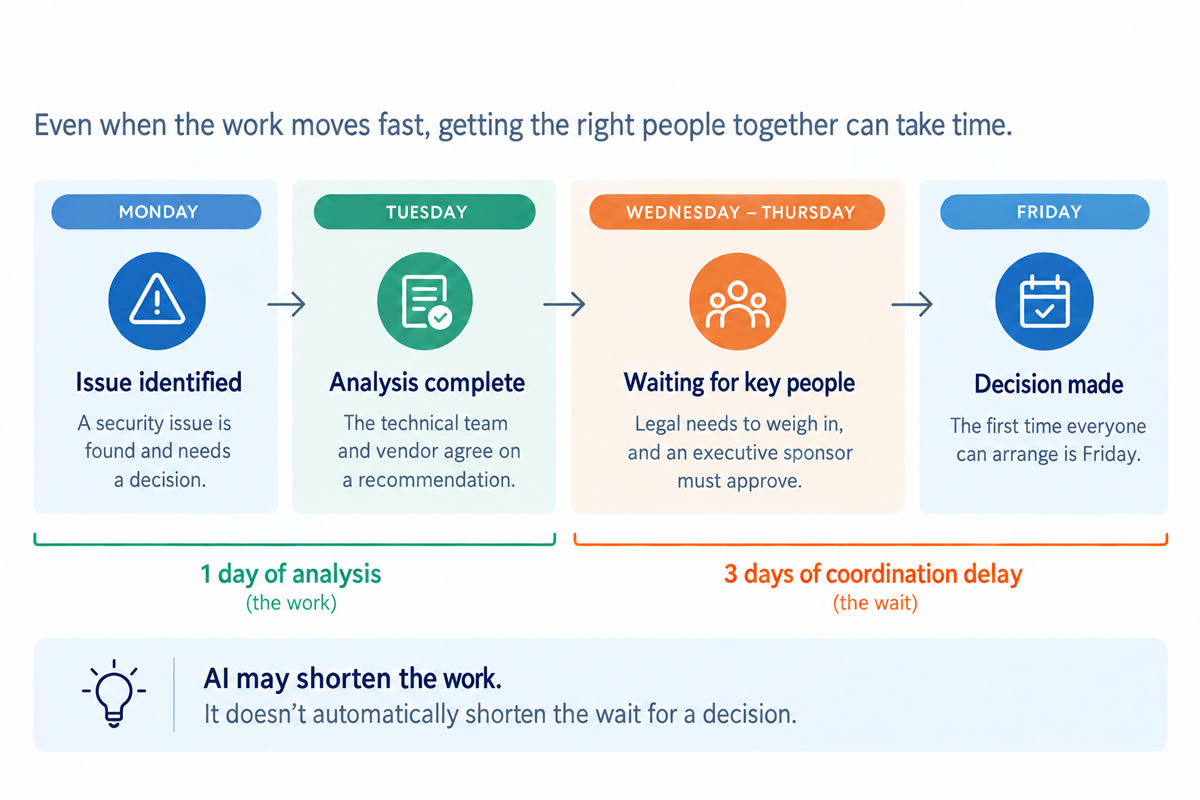
The analysis took one day. Waiting for the decision took three more. As AI compresses the time required to analyze the issue and develop the recommendation, those three days become harder to ignore.
On a large program, the calendar chase is not always just administrative overhead. It can become part of the critical path.
The useful distinction is between the time required to understand and solve an issue and the time spent waiting for the people with the necessary authority and expertise to act on the answer.
Pre-wire the path for decisions that happen repeatedly
Program managers can remove some of that delay before an issue occurs.
Most programs already do this for steering committees. The members, authority, and cadence are known in advance. The same thinking can be applied to decisions that arise unexpectedly.
For a serious security issue, for example, define:
- Which roles need to participate
- Who has decision authority
- Who can act as an alternate
- How quickly the group needs to meet
A dependency threatening this week’s milestone should not follow the same path as a design question affecting work next month. This does not mean adding more standing meetings. In my experience, large programs already have plenty of those.
For recurring transformation-team meetings, the PMO can define the scheduling path in advance. Urgent decisions need a similar fast path, but without turning every possible issue into another standing meeting.
The better approach is to create a fast path for bringing the right people together when a real decision appears.
Modern program governance should answer not only who decides, but how quickly the program can get those people into position to decide.
Cross-company programs make availability harder to trust
This is where something that looks simple on a program chart becomes much messier in practice.
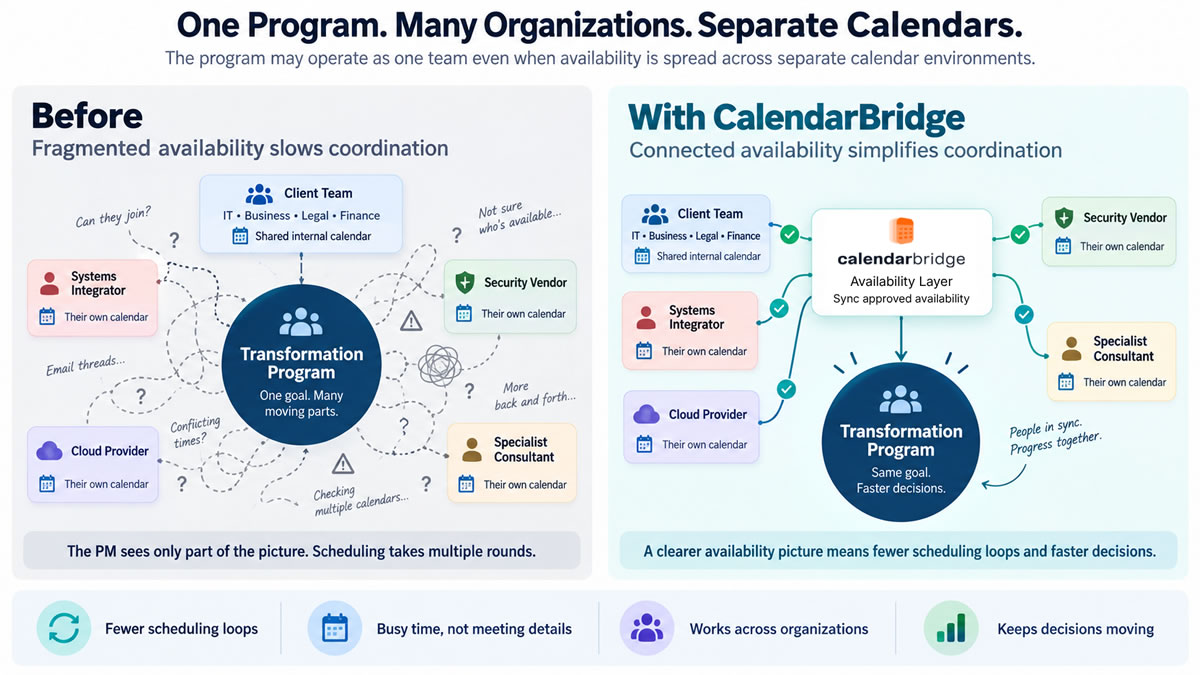
A major transformation might include the client’s business and IT teams, a systems integrator, cybersecurity firm, cloud provider, data partner, specialist consultants, and software vendors. It can become an alphabet soup of companies and acronyms very quickly.
Yet one cutover problem may require people from four or five of those organizations in the same decision meeting.
Everyone is working toward the same program outcome. Their calendars may live in entirely separate Microsoft 365 or Google environments.
Someone can appear free at 2:00 p.m. in the calendar the PM can see while another work or client calendar already contains a meeting. The first proposed time fails. Another email round begins. The decision moves further away.
That is an important lesson we have learned at CalendarBridge: availability is only useful if it reflects the person’s real commitments.
One CalendarBridge customer works across three businesses. Before his calendars were connected, assistants in the different companies had to coordinate with one another simply to understand when he was actually free. Once his commitments were reflected across those calendars, each assistant could schedule from a more complete picture.
CalendarBridge addresses that problem by keeping approved calendars synchronized. If a meeting on one calendar should make someone unavailable elsewhere, that time can appear as busy on the other calendar as well. The scheduler still works in Outlook or Google. There is no new calendar to check.
The important change is getting a more accurate answer to a basic question:
When can these people actually meet?
Share enough availability to coordinate without exposing private details
Cross-company availability also creates a privacy question.
A consultant may need the program to know that 2:00 is unavailable without revealing another client meeting.
One CalendarBridge customer working across compliance-sensitive healthcare and aviation environments put it simply:
“They just need to know that I’m busy or free.”
That is often all the scheduling process needs.
CalendarBridge can reflect the conflict without copying the underlying meeting details. The goal is enough shared availability to coordinate the work without requiring companies to merge calendars or expose information they should keep separate.
This can be especially useful on acquisitions, integrations, and other cross-company initiatives where people need to start working together immediately even though their Microsoft 365 or Google environments remain separate.
The program may need to operate as one team long before its systems do.
Automate the coordination after the PM defines the decision
Accurate availability reduces the number of failed scheduling attempts, but it does not eliminate the coordination work.
Five people may still have no obvious opening, someone may decline, or an outside participant may have a conflict CalendarBridge cannot see.
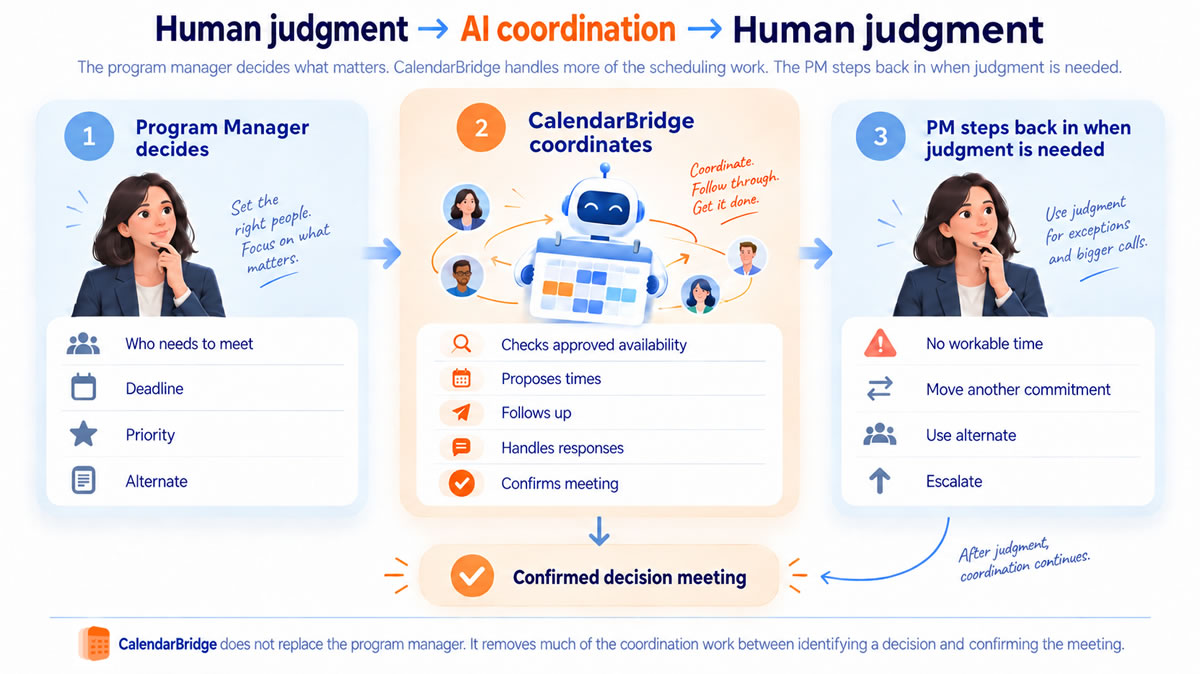
Once the PM has decided who needs to meet, when the decision is needed, and any important constraints, the CalendarBridge AI Scheduling Assistant can handle much of the routine back-and-forth.
During my years managing large programs, I often used the phrase “herding cats” for this kind of coordination work: chasing responses, rechecking availability, proposing alternatives, and trying to assemble the right decision-makers before the issue caused another delay.
A request might be:
Please coordinate a 30-minute meeting with everyone on this thread by Wednesday afternoon. Avoid Tuesday morning.
For calendars it is authorized to use, the assistant can work from known availability, propose times, communicate with participants, follow up, adjust when plans change, and send the invitation once the group agrees.
If an external participant’s calendar is not connected, the assistant does not suddenly gain access to it. It can coordinate with that person through email instead.
That boundary matters. Technology can execute the coordination it has been authorized to perform without bypassing organizational controls.
The larger benefit is that the program manager no longer needs to remain involved in every scheduling exchange.
Keep the quarterback focused on the decisions AI should not make
The handoff to AI has a clear limit.
CalendarBridge can determine that there is no common opening before Wednesday. It should not decide that an executive sponsor’s customer meeting is less important than the program escalation.
That is where the program manager — a.k.a. the quarterback — adds value.
Should the PM use the alternate? Move another commitment? Reduce the attendee list? Escalate? Those decisions require context, authority, and judgment.
A principle we try to keep clear at CalendarBridge is that automation should remove coordination work, not pretend that prioritization no longer requires a human.
Scheduling friction can reveal a bigger program problem
Working this close to calendars has reinforced something we think PMOs should pay attention to: coordination problems can become visible in calendars before they appear neatly in a status report.
Suppose the same executive repeatedly appears in decisions that cannot happen quickly. Each delay might have a reasonable explanation. The executive was traveling Tuesday. Wednesday was full. Friday was the next opening.
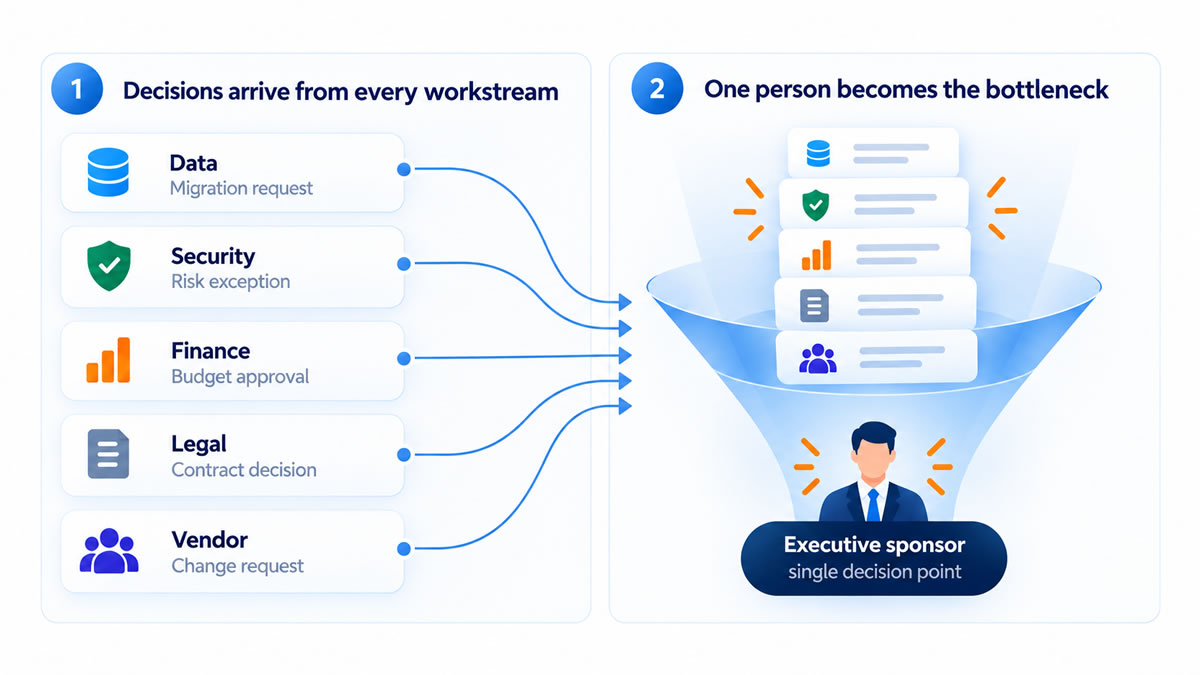
But if the same person is delaying ten different decisions, the program may not really have a scheduling problem. It may have too much decision authority concentrated in one person.
The same pattern can appear around Security, Legal, Finance, Architecture, or another shared function.
CalendarBridge cannot create more executive capacity, and scheduling automation cannot fix a governance bottleneck. But repeated difficulty assembling the same stakeholder for time-sensitive decisions is useful operational evidence.
The PMO can respond by delegating decisions, establishing approval thresholds, naming alternates, or reserving dedicated decision windows.
Sometimes the calendar friction is telling you something about the program design itself.
Measure the time decisions spend waiting
That leads to one final practice I think PMOs should consider: distinguish the time spent solving a problem from the time spent waiting to act on the answer.
Imagine two decisions have both been open for seven days. One required six days of analysis. The other had a recommendation ready on day two and then spent five days waiting for the right people to meet.
Those are very different program problems.
For the second, the useful measure is:
Decision ready → decision made
Watch for decisions repeatedly waiting on the same stakeholders, urgent sessions that miss their expected timeframe, and cross-company meetings that require several attempts to schedule.
It does not need to become another elaborate dashboard.
The purpose is to identify where coordination is consuming time that faster execution was supposed to save.
Make decision-making keep pace with the work
AI is compressing the time teams need to analyze, create, and execute. Faster individual work does not automatically produce faster programs. Someone still has to connect the workstreams, bring the right people together, and make sure decisions happen.
Our perspective at CalendarBridge comes from a specific place: calendars are where people’s actual commitments collide with the way organizations expect work to happen.
A program plan tells you what should happen. The calendar often reveals whether the people required to make it happen actually have the capacity to do it.
Program managers can reduce that friction by defining decision paths in advance, making cross-company availability more reliable, and handing more routine coordination to AI while preserving human judgment for priorities and exceptions.
CalendarBridge does not make the program’s decisions. It helps shorten the distance between a decision that is ready and the people who need to make it.
As AI makes the work faster, the next challenge is making sure decision-making can keep up.